v1.1.0 — Flux node support, Insight Explorer mode, wallet & benchmark monitoring

Your Raspberry Pi 5,
Your Media Server

HarbourOS turns your Pi 5 into a dedicated, native Plex Media Server. No Docker overhead. No generic app store. Just Plex — optimised for direct play, managed from a beautiful web dashboard.

curl -sL https://harbouros.eu/install.sh | sudo bash
harbouros.local:8080
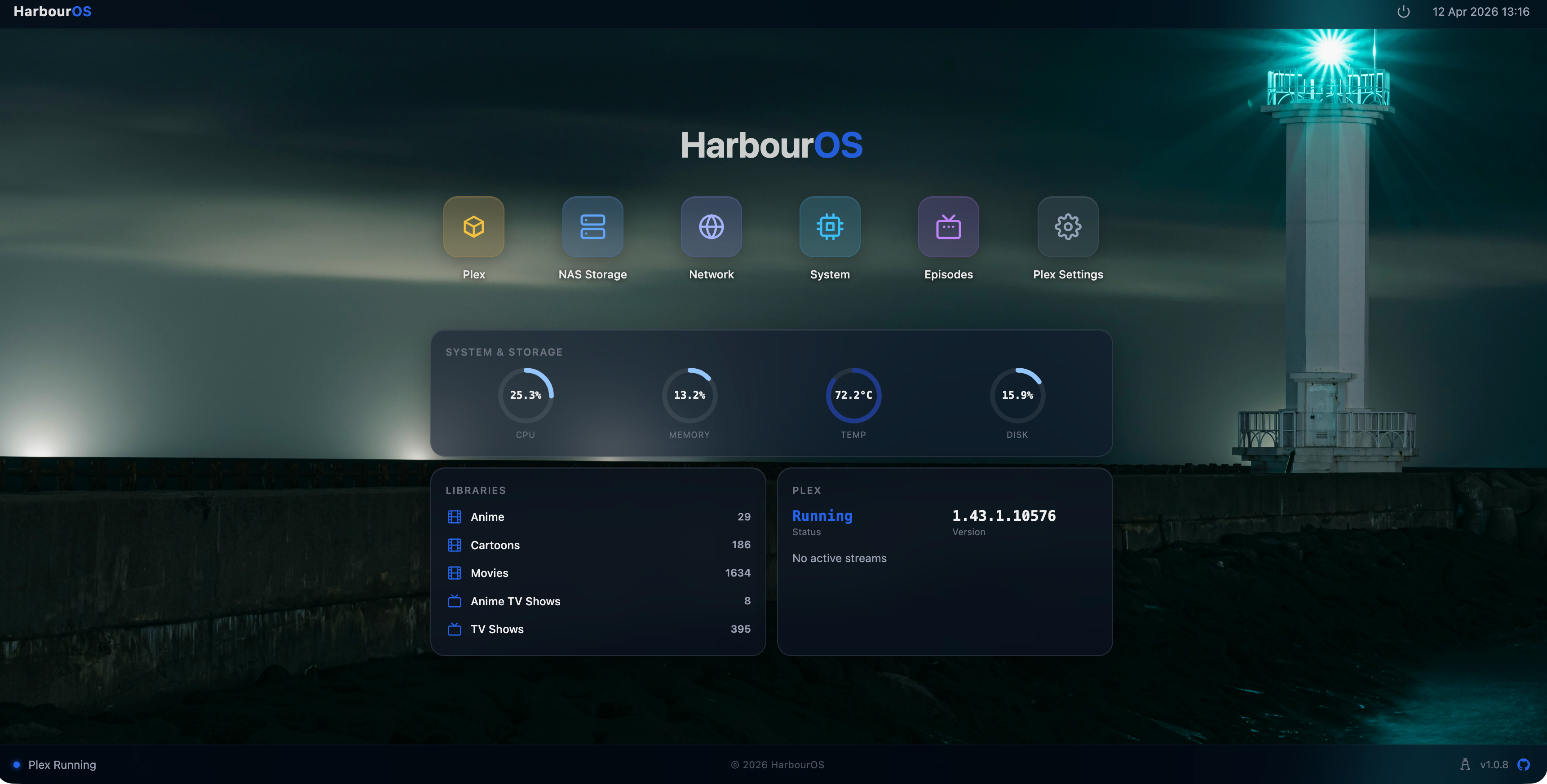
HarbourOS admin dashboard — real screenshot
Raspberry Pi 5
Security Hardened
Open Source · MIT
85 Tests Passing
No Docker required

Everything your media server needs

A complete, purpose-built appliance OS. Every feature exists to make your Plex server better.

Live

Full Plex Control

Start, stop, and restart Plex with one click. View real-time logs, monitor library status, and let HarbourOS handle updates automatically. Zero command line.

Auto-update
Real-time logs
Library status
One-click restart
Plex Media Server
Running
Movies
847
TV Shows
124
Music
3.2k
Live

NAS Storage in Seconds

Auto-discover NFS and SMB shares on your network. Mount and manage network storage visually — no terminal, no fstab. Mounts survive reboots.

NFS & SMB
Auto-discovery
Persistent mounts
Mount diagnostics
New

Episode Manager

Compare your Plex TV library against 185,000+ shows and 5.7M episodes. See exactly which episodes are missing, per season, with completion tracking.

Breaking Bad
62/62 · 100%
Severance
14/19 · 5 missing
New in v1.1

Flux Node Management

Run a Flux CUMULUS node alongside Plex on the same Pi 5. HarbourOS configures Insight Explorer mode, manages fluxd and fluxbenchd, and monitors your node status, benchmark results, wallet balance, and earnings — all from the dashboard.

CUMULUS tier
Insight Explorer
Benchmark monitor
Wallet & earnings
Auto-install

System Health

Real-time CPU, RAM, temperature, and disk metrics. Ring gauges. Service status at a glance.

Live Sessions

See who's streaming, on which device, and whether they're direct playing or transcoding.

Security Built-in

fail2ban, CSRF protection, SSH hardening, and rate limiting — active by default and visible in the Security tab.

~0.2%
Idle CPU usage on Pi 5
~35s
Boot to Plex ready
185k+
Shows in episode database
Built for one thing: Plex on a Pi.
Not an app store. Not a NAS OS.
Just your media server, done right.

HarbourOS is a single-purpose appliance OS. Every feature, every default, every trade-off is made for one goal: a reliable, low-maintenance Plex server that just works.

New in v1.1.0

Run a Flux Node and Plex
on the Same Pi 5

HarbourOS v1.1.0 adds first-class Flux CUMULUS node support. One Pi 5, two revenue streams — your media server and your infrastructure node, managed from the same dashboard.

Production-ready
Flux infrastructure

HarbourOS configures fluxd with Insight Explorer mode — the only configuration that eliminates P2SH transaction crashes without patching FluxOS source. Install, sync, and confirm your Cumulus node from the web UI.

  • One-click install — HarbourOS installs fluxd, FluxOS, fluxbenchd, and MongoDB with the correct Insight Explorer configuration.
  • Zero P2SH crashes — insightexplorer=1 routes FluxOS through the safe processInsight() code path.
  • Dashboard monitoring — Node status, benchmark results, wallet balance, earnings, and sync progress — all live in the admin UI.
  • Coexistence optimised — MongoDB cache tuned, OOM priorities set, Plex hardware transcode enabled. Both services run without starving each other.
  • Auto-restart on reboot — All Flux services (zelcash, fluxbenchd, FluxOS, watchdog) are wired into systemd and pm2 for unattended recovery.
CUMULUS
Tier — Raspberry Pi 5 meets all requirements
~4–5d
First reward after node confirmation
~900
EPS benchmark score on Pi 5
0
P2SH crashes with Insight Explorer mode
zelcash.service (fluxd) active
fluxbenchd.service active
FluxOS (pm2) online
mongod.service active
plexmediaserver coexisting
Pi 5 requirement: Flux Cumulus tier needs 8 GB RAM, NVMe storage, and a 27W USB-C power supply. The Pi 5 (8 GB) meets all criteria with the official Active Cooler.

Up and running in minutes

From unboxing to streaming — no Linux experience required.

1

Install HarbourOS

Flash the image to an SD card, or install remotely over SSH onto a running Pi.

2

Connect Storage

Open the web dashboard and connect your NAS. Devices are auto-discovered on your network.

3

Start Streaming

Plex is pre-installed and ready. Add your libraries and stream to any device.

Built differently for Plex

There are other ways to run Plex on a Pi. Here's why HarbourOS is purpose-built.

Built for Plex. Nothing else.

  • Native Plex, no Docker — Plex runs directly on the OS. No container overhead means faster startup and less memory wasted on infrastructure.
  • Single-purpose design — No app store, no extra services, no containers. Every feature in HarbourOS exists to support your Plex server.
  • ~0.2% CPU at idle — Measured on a live Pi 5 with Plex running. The Pi sits quiet until someone starts streaming.
  • Security out of the box — fail2ban, CSRF protection, rate limiting, and SSH hardening — all enabled by default, all visible in the Security tab.
CasaOS and OpenMediaVault are excellent general-purpose NAS OSes. HarbourOS does less, and does it better for Plex.

What to expect on a Pi 5

  • Direct play is excellent — The Pi 5 handles 1080p and 4K direct play to any Plex client without breaking a sweat.
  • Transcoding is limited — Software transcoding is CPU-bound. Expect around 2 simultaneous 1080p transcodes before performance degrades.
  • Best for 1–4 streams — Ideal for a household where most clients support direct play. Apple TV, Roku, smart TVs, and modern phones all do.
  • Not for heavy transcoding — If most of your clients force transcoding, or you need 4+ simultaneous streams, a more powerful server is a better fit.
Tip: Enable "Allow Direct Play" in your Plex client settings to get the best experience on a Pi.

Works with your setup

Built for Raspberry Pi 5 and integrates with the storage and clients you already use.

Hardware

Raspberry Pi 5 (4 GB)
Raspberry Pi 5 (8 GB)

Storage

NFS
SMB / CIFS
USB Drives
Synology
QNAP
TrueNAS

Stream To

Smart TVs
iPhone / Android
Web Browser
Apple TV
Roku
Game Consoles

Lean by design

HarbourOS strips out everything that isn't Plex. Here's what that looks like in practice.

~310 MB
Plex process footprint
vs 400–500 MB with Docker
~0.2%
Idle CPU usage
Measured on Pi 5, Plex running
~35s
Boot to Plex ready
From power-on to first stream
~10 min
Setup time
vs 30–45 min with Docker/CasaOS
Metric HarbourOS CasaOS + Docker Bare Docker
Plex RAM ~310 MB ~500 MB+ ~400 MB+
Setup time ~10 min 30+ min 45+ min
Plex-optimised Purpose-built Generic OS Partial
Security hardening Built in Manual Manual
Admin UI Plex dashboard Generic app store None

Plex process RSS measured on Raspberry Pi 5 (8 GB) with one NAS mount active. CPU idle at the same time. Boot time is an estimate.

What's shipping, what's next

Built in the open. Progress is always visible.

Shipped

Plex control & auto-update
NAS mount management (NFS & SMB)
Episode Manager (185k+ shows)
Backup & restore
Security tab & hardening
Mount diagnostics
Plex session monitoring
Self-update with changelog
Setup wizard & onboarding
Storage health warnings
Ring gauge dashboard
Flux CUMULUS node support

In Progress

Remote access via Tailscale
SMART disk health monitoring
Plex library scan triggers

Coming Next

Plex client pairing UI
Multi-user admin access
Subtitle burn-in warnings
NAS throughput test
Mobile companion app

Open Source, Built in the Open

HarbourOS is free, MIT-licensed, and developed publicly on GitHub. Contributions, issues, and ideas are always welcome.

MIT
License
100
Tests Passing
v1.1.0
Latest Release

Ready to build your media server?

Free, open source, and yours forever. No subscriptions, no cloud dependency.

curl -sL https://harbouros.eu/install.sh | sudo bash